https://mulberry-bush.epexio.com/records/OXFORD
From the Catalogue entry (the full entry is at the url above)
| CORRECTIONS/EMENDATIONS | ||
| Reference number |
|
|
| Level of description |
|
|
| Category |
|
|
| Scope and content |
|
"Leach" As the 2023 publications cited below show, the Project was about more than the Phoenix Unit It specifically did not seek the memories of former residents |
| History |
|
not patients Both Peter Agulnik and Jonathan Leach were part of the coordinating group, but see the History of Psychiatry special issue, 34:1 (2023) for a more accurate record. Until his death our colleague David Millard played an essential leading, driving and coordinating role. |
| Access status |
|
|
| Conditions governing access |
|
The Project has concluded. The Steering Committee no longer exists. |
| Conditions governing reproduction |
|
|
| Archival history |
|
"Leach" |
| Existence and location of copies |
|
|
| Physical characteristics and technical requirements |
|
How many? What kind:
|
| Title |
|
|
| Date(s) description was created |
|
Comments
The PETT Archive and Study Centre does not appear in the catalogue description above. And yet:
"The anchoring point has been the Planned Environment Therapy Trust (PETT) Archive and Study Centre (1989–2018), abbreviated hereafter as the PETT Archive." (1)
The Oxford Project was part of the Planned Environment Therapy Trust Archive and Study Centre's Oral History Programme, with origins traced back to a meeting of archivist Craig Fees and psychiatrist and historian of psychiatry David Millard in 2000 (2). The research stage of the Project concluded in 2016 with the last of five witness seminars, each recorded by the archivist, this one devoted to the Phoenix Unit, hosted at the Planned Environment Therapy Trust, with the archivist co-facilitating as well as recording (3). So much involvement, over such an extended period, will show up throughout the Archive and Study Centre's files and documentation. But it doesn't show up in the Mulberry Bush/archive catalogue description. Why?
The closest answer is the Rupture: the decisions which led to the exclusion of anyone with knowledge of the institutional history of the Archive and Study Centre from the new Archive (discussed here); and the lack of self-grounding in that history through studying its documentation on the website (e.g., the Phoenix Unit website embedded within the PETT website, here); newsletters (e.g., here), Archivist's reports, Archivist's correspondence, the oral history catalogue, the master audio files, and the transcripts which the Archive held (the methodology of the Project is described here, including: "The recordings and transcripts, edited by the contributors, are held at the PETT Archive"); and the Accessions Register.
If the documentation had been destroyed by the time the catalogue came to be made, or was not accessible to the cataloguer, those could be additional reasons. Absent every source of information but the files themselves, the thirteen witness seminar recordings and their transcripts might have triggered a query. But they do not appear in either the TC VOICES or TC EVENTS catalogues, so either they weren't seen as part of that re-cataloguing project or hadn't been included at the time the TC Events catalogue was last updated, or weren't available, or perhaps had been deleted.
The Project was partly written up in 2018 in Armstrong, N (2018) "What leads to innovation in mental healthcare? Reflections on clinical expertise in a bureaucratic age", Psychiatrtic Bulletin 42(5): 184–187; and in 2019 in Leach,JSR (2019) "Madness and chaos in the culture of a therapeutic community", International Journal of Therapeutic Communities 40(1): 16–24. The findings of the Project were published as a special issue of History of Psychiatry in 2023: History of Psychiatry 2023, Vol. 34(1).
Footnotes are below the Alarms. For Accuracy and Ownership, this catalogue is a strong argument for building archival practice, as a matter of course, around the engagement of those who donate or loan or are represented in the collections a catalogue describes.
Alarm Bells
Where - in what sources - could we expect to find information about the role of the Archive and Study Centre in the Oxford Project, given its involvement, and as one of its oral history projects? And have these sources not been used because they no longer existed at the time of cataloguing, because the cataloguer wasn't aware of them, or is something else involved?
1. ORAL HISTORY CATALOGUE
2. ARCHIVIST'S REPORTS
3. ARCHIVIST'S CORRESPONDENCE
4. THE WEBSITE
5. PETT NEWSLETTERS
6. ASKING THE DONORS/SEEKING A KNOWLEDGEABLE PERSON
7. THE PUBLISHED LITERATURE
8. ACCESSION REGISTER
Footnotes
1. Millard et al. (2023) "Innovation in mental health care: Bertram Mandelbrote, the Phoenix Unit and the therapeutic community approach", History of Psychiatry Vol 34 (1), p. 19.
2. Hall et al. (2023) "The processes and context of innovation in mental healthcare: Oxfordshire as a case study", History of Psychiatry Vol 34 (1), p. 3.
3. In date order the five Witness Seminars were (In the Archive's cataloguing system "CF" indicates a recording in the Craig Fees Collection; taken from Millard et al. (2023), p. 32):
Oxford Therapeutic Communities Witness Seminar (at Littlemore), 25 April 2013, Ref: CF0923-0924.
Oxford Project Witness Seminars (at Littlemore; recorded by Craig Fees): 6 February 2014, Ref: CF0996-0997; 26 March 2014, Ref: CF0998-0999.
Elmore Community Support Team Witness Seminar (at Littlemore; recorded by Craig Fees), 15 January 2015, Ref: CF1049-1050.
Phoenix Unit Reunion Witness Seminar (at PETT Archive), 19 October 2016. Ref: CF1161-1165.
<!-- 2026-02-11>
Note:
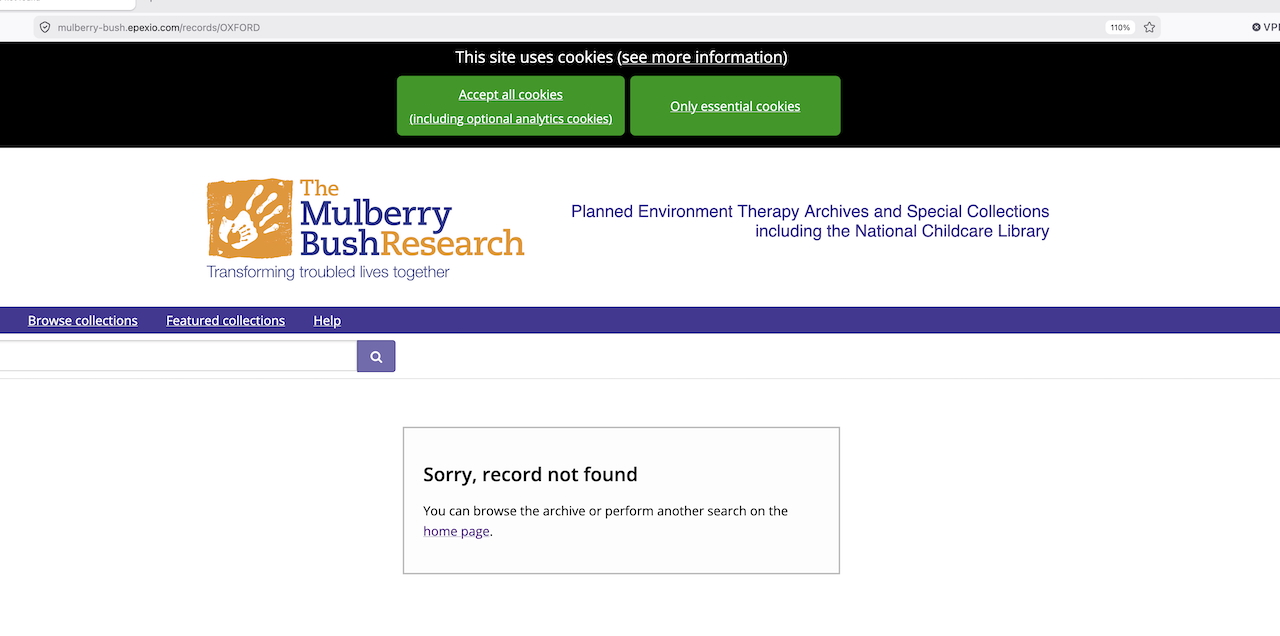
Added 2026-05-28: As per the screenshot below, as of 2026-05-28, and perhaps earlier, the catalogue description is no longer available in the Mulberry Bush Archive online catalogue. A brief search on 2026-06-19 shows that a number of catalogue descriptions have now been removed (e.g, Red Hill School, Finchden Manor, Warleigh Manor, Hengrove School, and others).