Introduction to Gleanings
As the final deadline to vacate the Toddington site on June 30th 2026 approached, with books from the library having gone to all the partnering archives which wished them, MB3 threw open its doors with a "come one, come all: take books" . The ultimate alternative for the remains of the Archive's former Research Library was the skip.
There were too many books for Oxfam and most secondhand book dealers, and even The Book Rescuers was defeated by the logistics.
I visited on the 25th, the last Thursday in June. The main object of my visit was not books - I thought I would be able to return - but to pick up four boxes of archives and a few other things which had been set aside for me as a Depositor, and then to accompany the welcoming and generous venue manager Mike Staines on a tour of the building and grounds to identify and try to suggest where and to whom indoor and outdoor museum objects - not wanted by tradition-bound archives, strangely - might go. The building was filled with packed and labelled boxes, with a magnificent sense of purpose and order. The grasses on the field were high.
As I was leaving, and encouraged by Mike, I quickly picked out about a dozen books from several dozen in a set of short shelves on a wall in the main Hall. There will have been books elsewhere, and it is to my regret that I didn't take time then to see these. A more flexible secondhand book dealer came along not long after, and took away all the books that remained.
It wasn't until I got home that I looked closely at what I had. These "Gleanings" share four books that stood and stand out. Three came from the libraries of three eminent figures in the therapeutic community movement, professional libraries which I had picked up, boxed, and brought to the Archive many years before; each book a classic/basic reading in therapeutic community history, with a story to tell. The fourth was/is part of my personal history in a different way.
Gleaning 2: Maxwell Jones, 'Social Psychiatry in the Community, in Hospitals, and in Prisons', with a Foreword by Richard A. McGee and a Preface by J. Douglas Grant, Charles C. Thomas, Springfield, Illinois, 1962.
*
Social Psychiatry is a basic text in the history of post-War therapeutic community. It is made up of a series of lectures written by Maxwell "The Father of Therapeutic Community" Jones in 1959-1960 when Commonwealth Visiting Professor in Psychiatry at Stanford University in California. The book came from the library of David H. Clark. It is signed on the front free endpaper, as you can see from the scan below, but is not dated. I reckon David got it in 1962.
In 1962, by the time Social Psychiatry was published, Max was Director of Education and Research at the Oregon State Hospital in Salem, Oregon, and Clinical Professor of Psychiatry at the University of Oregon Medical School in Portland, Oregon, as well as a Member of the Expert Advisory Panel of the World Health Organization. He was a risen and rising star in the international world of Social Psychiatry, with English and American versions of his first book well behind him(fn1).
David Clark, meanwhile, had been Medical Superintendent at Fulbourn Hospital in Cambridge since 1953 - "nine exciting years"(fn2) - in which he became responsible for "a static, custodial mental hospital rather more overcrowded and certainly more impoverished than most, with a static and discouraged feel to it", which transformed under his leadership into an active and lively Open Door hospital, with a rehabilitation half-way house and a number of therapeutic communities within the hospital itself [as he describes here].
He first directly encountered Maxwell Jones and Belmont Hospital (later renamed Henderson Hospital) in the very early 1950s before his move to Cambridge, while he was working at the Maudsley Hospital. It was "an exhilarating, paradigm changing moment for me," he wrote:
For some years I had been pondering on the life of the old mental hospitals, with the locked doors, oppression, brutality and bizarre rituals, and wondering whether it could be different. I had read sociological studies and visited pioneering units. But Belmont was amazing. Here was a society where everyone - patients, doctors, nurses - were on first name terms and apparent equality; where open and frank discussion went on about the daily crises, examining the staff behaviour as freely and penetratingly as those of the patients. I was amazed and excited. Could this work elsewhere? Probably not, said the cynics... [reference here]
And yet....
He and Max became friends and colleagues, and while on a post-graduate year in the United States in 1962-63, David visited Max and his then-wife Kirsten in Salem several times. Surely it was during this year, and with visits in mind, that he would have bought (or even been given) his copy of Social Psychiatry in the Community, in Hospitals and in Prisons, hot-off-the-American-presses(fn3).
He was almost certainly working on his own first book at the time, Administrative Therapy, which was published by Tavistock in London in 1964; and perhaps his first article with "therapeutic community" in the title, with D.F. Hooper and E.G. Oram, "Creating a Therapeutic Community in a Psychiatric Ward", Human Relations, 1962, 15, 123 (For a list of David Clark's publications, compiled by Dr. Clark himself, see here). This might explain his focused annotations in the book (see below).
It would not be long before Max was kicked out of Salem: "Max was promoting change and controversy in the hospital and the small town of Salem with vigorous glee and, as ever, arousing devotion and opposition around himself". David wrote more of Max's life and career here.

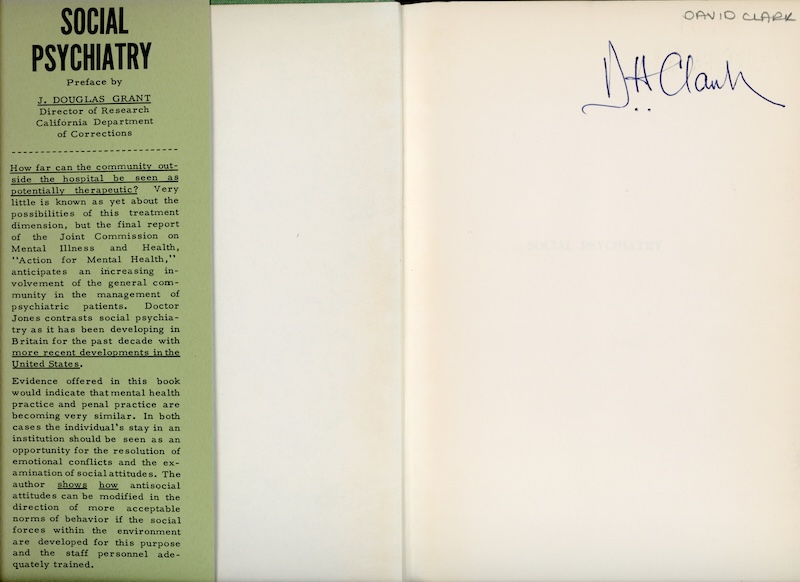
David Clark annotated Social Psychiatry very sparingly - there are only two pencil linings alongside text in the whole of the book - and these are very systematically indexed by page number with the note "Definn of Ther Comm" on the back free endpaper.

What he drew his attention to:
pp. 53-54
[I have elsewhere described a therapeutic community] as distinctive among other comparable treatment centers in the way the institution's total resources, both staff and patients, are self-consciously pooled in furthering treatment....The term implies that the whole community of staff and patients is involved at least partly in treatment and administration.
p. 73
...there is, as yet, no one model of a therapeutic community and all that is intended is that it should mobilize the interest, skills and enthusiasms of staff and patients and give them sufficient freedom of action to create their own optimal treatment and living conditions.
Footnotes
Footnote 1
Social Psychiatry: A study of therapeutic communities was published by the Tavistock Press in London in 1952. The American version, The Therapeutic Community: A New Treatment Method in Psychiatry, was published by Basic Books in New York in 1953.
The full author list is Maxwell Jones, with A. Baker, Thomas Freeman, Julius Merry, B.A Pomryn, Joseph Sandler, Joy Tuxford, and with a foreword by Goodwin Watson.
Footnote 2
"Nine Exciting Years" was the title of David Clark's unpublished history of the opening up of Fulbourn Hospital after becoming Medical Superintendent. It foreshadowed the publication of his The Story of a Mental Hospital: Fulbourn 1858-1983, Process Press, London, 1996, which The Planned Environment Therapy Trust helped to subsidise by pre-buying a significant or at least useful number of copies (I don't remember how many - visual memory-wise there were several boxes. The idea was to make them available for sale, and at least one copy was still available 30 years later, which I picked it up on my visit.)
Footnote 3
Two years after its publication, a review by J.K. Wing appeared in the British Journal of Psychiatry. "The book is mainly written with an American audience in mind", he wrote, "and the impression left on the British reader is patchy." Having said which, "This is not a book to miss."
Wing JK. (1964) "Social Psychiatry: In the Community, in Hospitals, and in Prisons. By Maxwell Jones. Springfield, Illinois: Charles C. Thomas", British Journal of Psychiatry, 110(464), p. 122.